- Introduction: Baking Pan Design Is More Than Just Shape and Size
- Smooth vs. Corrugated Baking Pan Surfaces: What's the Difference?
- Different Edge Designs and Their Practical Benefits
- Single-Mold vs. Multi-Mold Baking Trays
- How Pan Dimensions and Mold Layout Affect Production Efficiency
- Choosing the Right Baking Pan Structure for Different Products
- Why Custom Baking Pan Design Matters for Commercial Production
- Tsingbuy: Custom Industrial Baking Pan Designs for Different Applications
In commercial and industrial baking, baking pans do much more than hold dough or batter during the baking process. Their design can influence heat transfer, airflow, product shape, baking consistency, handling efficiency, and even the overall productivity of a bakery.
For small bakeries, a standard baking pan may be sufficient for many applications. However, as production volumes increase, details such as perforation patterns, surface structures, edge construction, mold layout, and pan dimensions become increasingly important.
A baking pan that is not properly designed for its intended application may lead to uneven baking, inconsistent product shapes, difficult demoulding, or unnecessary handling challenges. On the other hand, a well-designed pan can help commercial bakeries maintain consistent product quality and improve production efficiency.
In this article, we explore several important aspects of baking pan design and explain how different structures serve different commercial baking requirements.
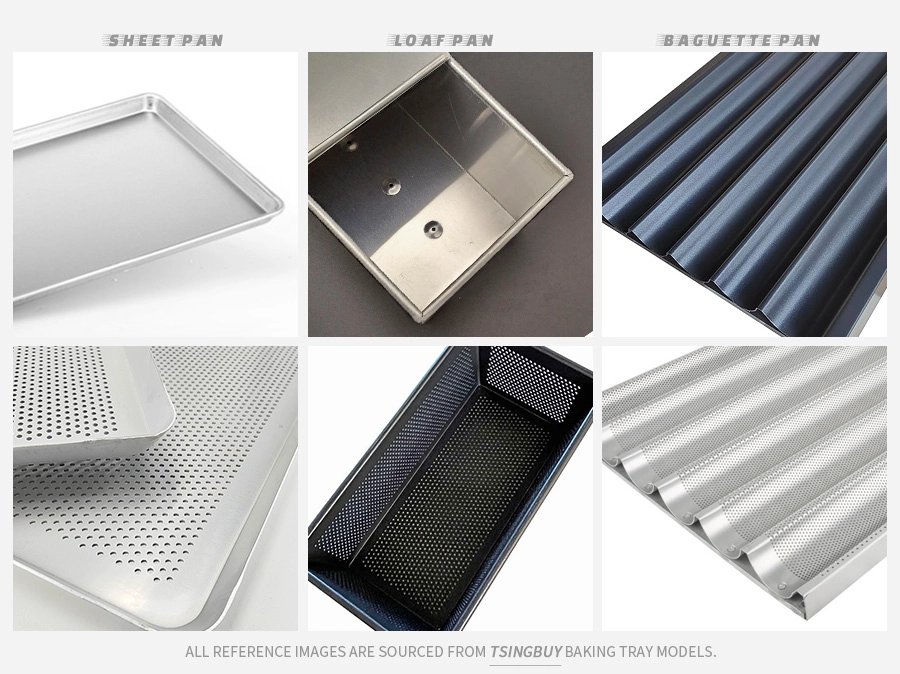
One of the most important design choices is whether to use a flat baking pan or a perforated one. The difference is not simply the presence or absence of holes. It can also affect airflow, moisture release, and the baking characteristics of different products.
Flat Baking Pans
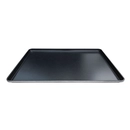
Flat baking pans have a solid surface without perforations. They provide continuous support for dough and other bakery products.
Common applications include:
- Cookies and biscuits
- Sponge cakes and sheet cakes
- Pastries and other products requiring a stable baking surface
- General-purpose baking in commercial bakeries
Because the surface is continuous, flat pans are suitable for products that require full support during baking or may spread during the baking process.
Perforated Baking Pans
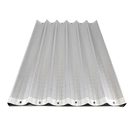
Perforated baking pans feature evenly distributed holes across the pan surface. These openings allow more air to circulate around the underside of the product and can help moisture escape during baking.
They are commonly used for:
- Bread and rolls
- Baguettes
- Certain pastry products
- Applications where improved airflow and bottom crust development are desired
The hole diameter, spacing, and distribution should be designed according to the product size and baking requirements. If the openings are too large or poorly positioned, small dough pieces may not be adequately supported.
Which Design Is Better?
Neither design is universally better. The right choice depends on the product, dough characteristics, oven system, and desired baking result.
For example, a solid sheet pan may be suitable for cookies, while a perforated tray may be more appropriate for certain bread products. Commercial bakeries should consider the complete baking process rather than selecting a pan based on appearance alone.
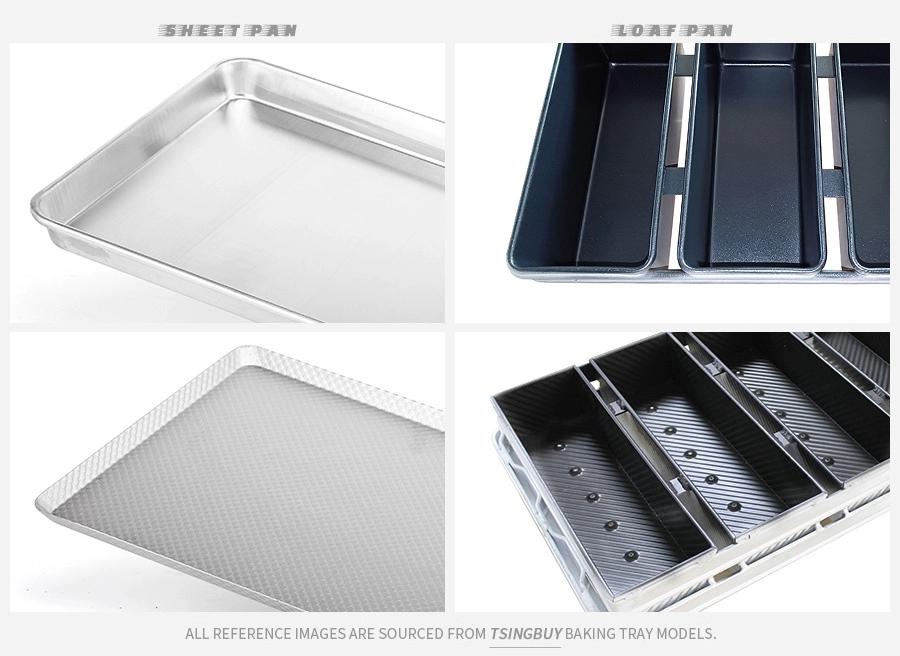
Besides the overall shape and dimensions, the surface texture is another important design feature of commercial baking pans. Depending on the product and manufacturing requirements, baking pans such as flat sheet pans and loaf pans can be made with either a smooth or corrugated surface.
The main difference lies in the surface profile. Smooth pans have a relatively flat and even surface, while corrugated pans feature a series of small, regular ridges and grooves.
Smooth Surface Baking Pans
Smooth surface baking pans have a flat, even interior without raised ridges or grooves. This design provides a continuous contact surface for bakery products.
Common applications include:
- Cookies and biscuits
- Sheet cakes and sponge cakes
- General-purpose baking
- Bread and other products requiring a smooth pan surface
Smooth surfaces are suitable for many standard commercial baking applications. They also provide a straightforward structure that is easy to clean and maintain.
Corrugated Surface Baking Pans
Corrugated baking pans feature a series of parallel or patterned ridges and grooves on the pan surface. This texture can be incorporated into flat baking sheets, loaf pans, and other baking pan designs.
Depending on the product and pan configuration, corrugated surfaces may offer several practical benefits:
- Surface structure: The ridges and grooves create a textured contact surface rather than a completely flat one.
- Pan rigidity: Corrugation can contribute to the structural stiffness of the pan, depending on its design and material thickness.
- Product contact: The textured surface changes the contact pattern between the pan and the dough or baked product.
- Product appearance: In certain applications, the surface texture may create subtle patterns on the product.
Corrugated pans are often selected for specific product requirements or when additional structural characteristics are desired.
Which Surface Should You Choose?
The choice between smooth and corrugated surfaces depends on the type of product, baking process, handling requirements, and desired pan characteristics.
For general-purpose baking, smooth pans are a practical option. Corrugated pans may be more suitable when a textured surface or a particular structural design is required.
When ordering customized baking pans, bakeries should consider the surface profile together with the pan material, thickness, dimensions, coating, and intended application. The right combination helps ensure that the pan meets both product requirements and daily production needs.
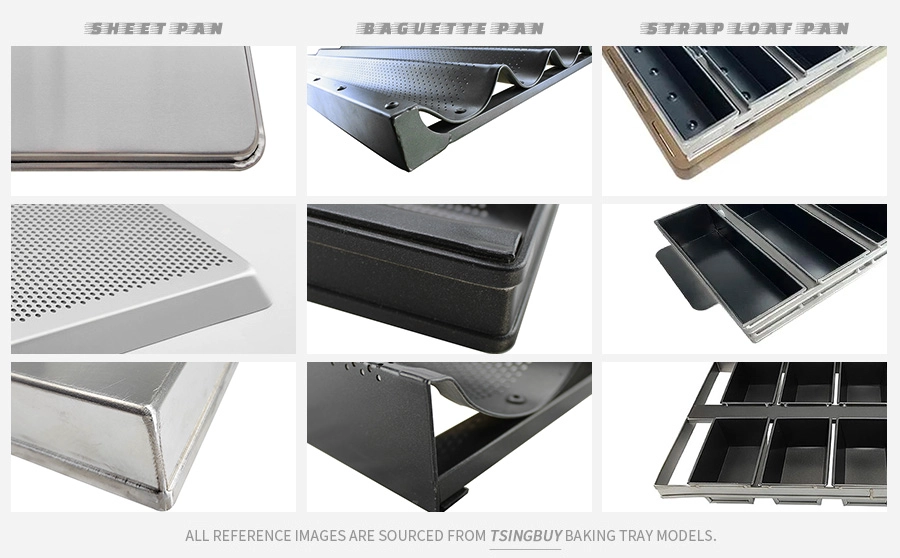
The edge of a baking pan may seem like a minor detail, but it plays an important role in structural strength, handling, durability, and compatibility with bakery equipment.
Different edge designs are suitable for different pan sizes, materials, and production environments.
Rolled Edges
Rolled edges are formed by folding the pan material along its perimeter. This creates a finished edge that is generally smoother and more rigid than a simple cut edge.
Potential benefits include:
- Improved edge strength
- Reduced exposure to sharp cut edges
- Better resistance to deformation during normal handling
- A more finished and consistent appearance
Rolled-edge construction is commonly used for commercial sheet pans and other baking trays.
Wire-in-Rim Construction
Wire-in-rim baking pans incorporate a reinforcing wire within the folded perimeter of the pan.
This structure can provide additional rigidity, especially for larger or heavier-duty baking pans used in demanding commercial environments.
It is particularly worth considering when pans are frequently loaded, unloaded, stacked, or moved between different stages of production.
Reverse-Folded Edges
Reverse-folded edges use a different folding direction to create a particular edge profile. Depending on the pan design, this construction can help meet specific requirements for strength, appearance, and equipment compatibility.
The appropriate edge structure should be selected according to pan dimensions, material thickness, expected loading conditions, and handling methods.
Choosing the Right Edge Design
For a small, lightweight pan, a standard folded edge may be sufficient. Larger industrial trays or pans subject to frequent handling may require additional reinforcement.
The objective is to achieve a suitable balance between structural strength, product weight, manufacturing requirements, and cost.
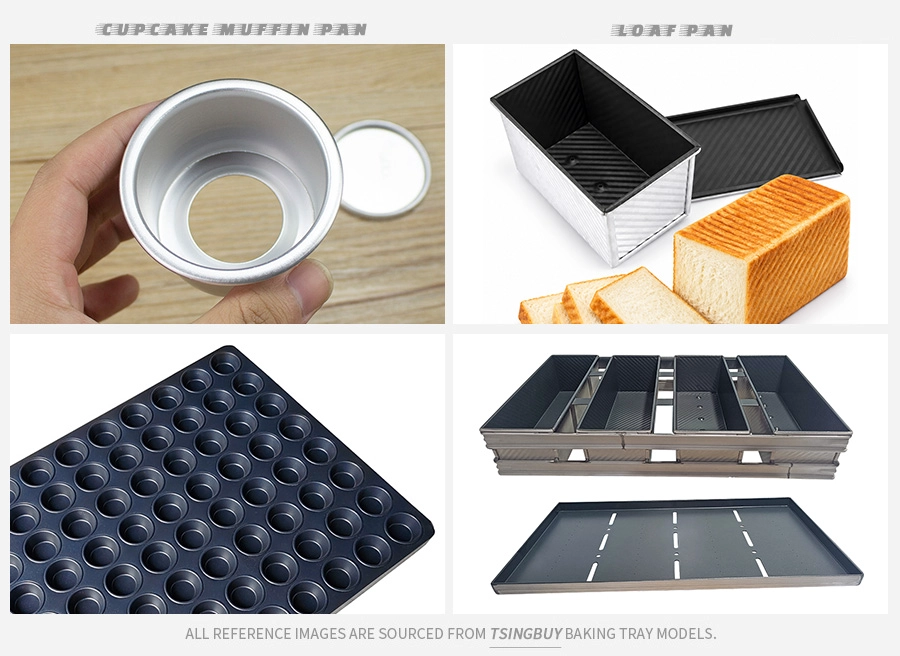
For bakeries and food factories producing individual cakes, muffins, desserts, and other portioned products, mold layout is another important part of baking pan design.
Single-mold pans and multi-mold trays serve different production needs.
Single-Mold Baking Pans
A single-mold pan is designed for one baking cavity or a specific individual product shape.
This type of pan is suitable for applications where:
- Products are relatively large
- Different product shapes are required
- Production batches are smaller
- Individual mold dimensions need to be customized
Multi-Mold Baking Trays
Multi-mold baking trays contain multiple cavities in one tray, allowing several individual products to be baked simultaneously.
They are commonly used for:
- Muffins and cupcakes
- Mini cakes
- Individual desserts
- Specialty-shaped bakery products
- High-volume food production
The number, shape, dimensions, and arrangement of the cavities can all be customized.
For example, a tray with 48 egg-shaped cavities or a tray with 65 oval cavities can be designed for specific products and production requirements.
For bakeries and food manufacturers with specific product requirements, working with an experienced custom tray factory in China can make it easier to develop multi-mold baking trays with tailored cavity shapes, dimensions, spacing, and layouts. Customized designs help businesses adapt their trays to different products and production processes.
How Mold Layout Affects Production Efficiency
A well-planned mold layout helps bakeries make better use of the available tray area.
Important considerations include:
- The number of cavities per tray
- Spacing between individual molds
- Distance from the molds to the tray edges
- Product dimensions and expected expansion during baking
- Compatibility with depositing, filling, and demoulding equipment
Increasing the number of molds is not always the best solution. The layout must also allow sufficient space for heat circulation, product expansion, cleaning, and handling.
For high-volume production, a customized multi-mold tray can be developed around the product and the equipment used in the production process.
Pan dimensions directly affect how baking trays fit into ovens, racks, conveyors, and other bakery equipment.
Even a relatively small difference in length, width, or height may influence equipment compatibility and handling.
Standard Pan Sizes
Many commercial bakeries use established tray dimensions to match their existing ovens and bakery equipment.
Common industrial baking pan sizes include:
- 400 × 600 mm
- 460 × 330 mm
- 460 × 660 mm
- 460 × 720 mm
- 600 × 800 mm
The actual dimensions required depend on the oven, rack, production line, and intended application.
Customized Dimensions
Not every bakery uses standard equipment or standard product formats. Some production lines require non-standard dimensions or special tray configurations.
Customized dimensions can help businesses:
- Match existing oven and rack specifications
- Improve the use of available oven space
- Adapt trays to conveyor systems
- Accommodate specific product sizes
- Coordinate trays with automated handling equipment
The Importance of Accurate Measurements
Before manufacturing, it is important to confirm the required external dimensions, internal usable area, edge structure, and any additional equipment-related specifications.
For multi-mold trays, the cavity layout should also be reviewed carefully to ensure that the tray meets both product and production requirements.
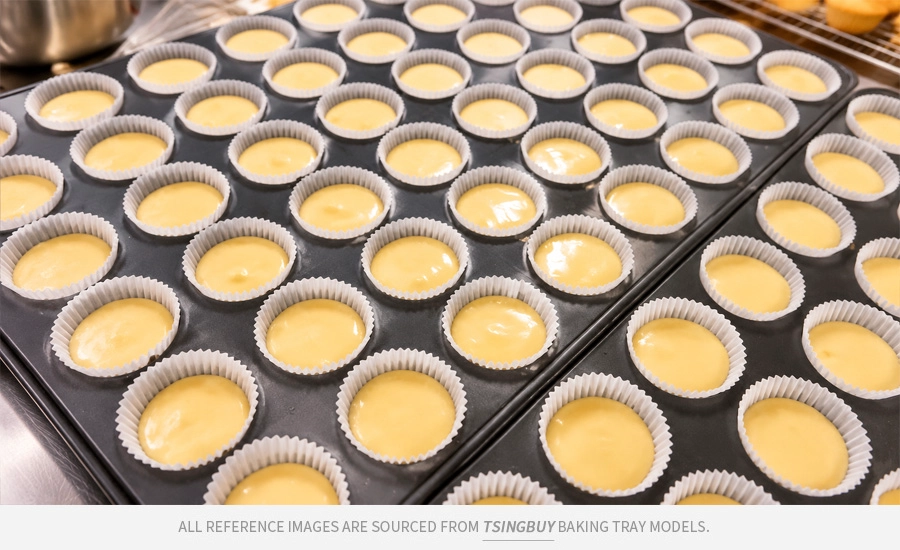
Different bakery products have different requirements for support, airflow, shape retention, and demoulding. The pan design should reflect these differences.
Bread and Loaf Products
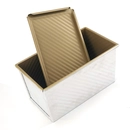
Loaf pans and Pullman pans are designed to support dough during proofing and baking while helping the finished bread maintain its intended shape.
Important design considerations include:
- Internal length, width, and height
- Straight or slightly tapered side walls
- Corner construction
- Surface coating
- Material thickness and structural strength
For Pullman bread, the design may also include a lid, depending on the desired product shape.
For bakeries producing bread on a commercial or industrial scale, choosing an experienced custom bread pan supplier in China can be valuable when standard loaf pans do not meet specific product dimensions or production requirements. Customized options may include pan dimensions, side-wall design, material thickness, surface treatment, and coating.
Baguettes
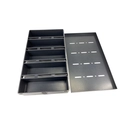
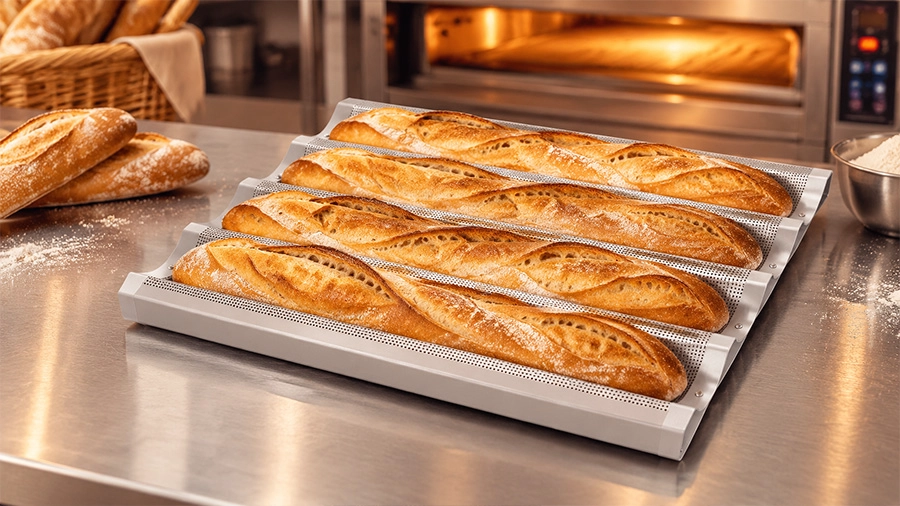
Baguette trays are often designed with multiple channels to support individual baguettes and help maintain their elongated shape during baking.
Important features include:
- Number of channels
- Channel width and depth
- Perforation design
- Overall tray dimensions
- Compatibility with oven racks and production equipment
For industrial baguette production, the number and arrangement of channels should be designed according to the target product size and production capacity.
Cakes, Muffins and Desserts
Multi-mold baking trays are commonly used for individual cakes, muffins, cupcakes, and other portioned products.
The mold shape, cavity depth, spacing, and coating all influence the finished product and demoulding process.
For specialty products, custom mold shapes can help manufacturers achieve a distinctive and consistent product appearance.
Cookies and Biscuits
Flat baking sheets are widely used for cookies and biscuits. Their dimensions, flatness, material, and surface treatment should be selected according to the baking process and the characteristics of the dough.
For automated production, pan dimensions and edge design should also be compatible with the depositing system, conveyor, and oven.
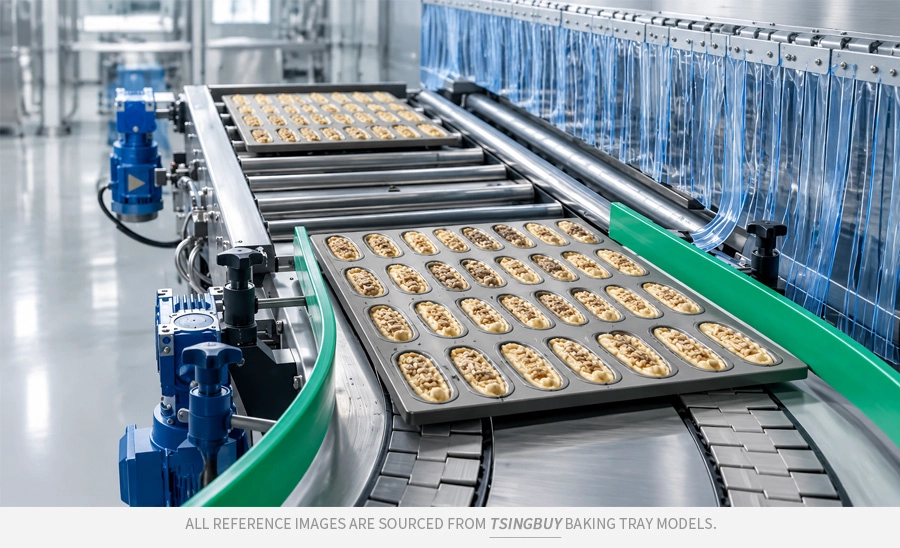
Standard baking pans can meet many common baking requirements. However, commercial bakeries and food factories may have specific product designs, production equipment, or operating conditions that require a more tailored solution.
Custom baking pan design allows manufacturers to develop products around actual production requirements rather than forcing a production process to adapt to a standard pan.
Customization may include:
- Pan length, width, and height
- Material selection and thickness
- Perforation size and distribution
- Fluted or corrugated surface structures
- Mold shape, depth, quantity, and layout
- Edge construction and corner design
- Non-stick coating options
- Special frames and reinforced structures
- Customized logos and packaging
For example, a bakery producing a specialty dessert may need a tray with a unique cavity shape. A bread factory may require a particular baguette channel layout. A large-scale bakery may need reinforced sheet pans designed for frequent handling.
In these cases, custom manufacturing can help create a better match between the pan, the product, and the production equipment.
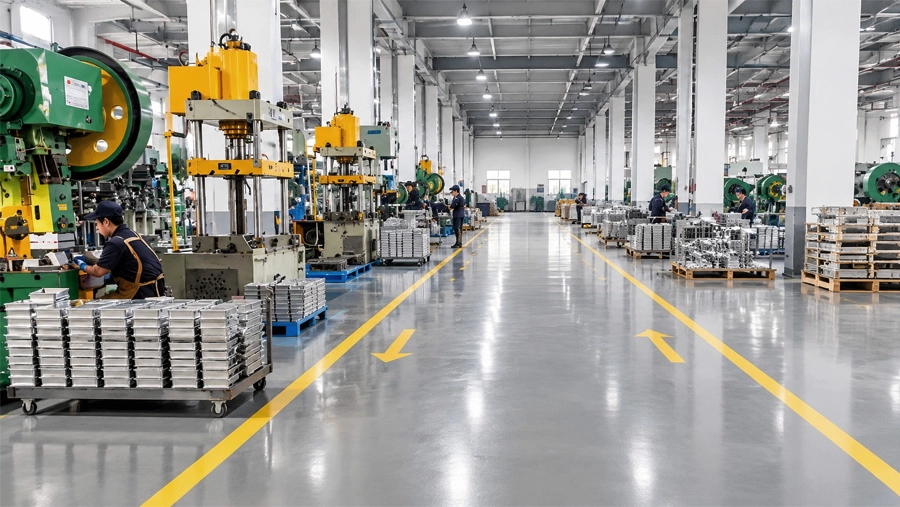
Since 2006, Tsingbuy has specialized in manufacturing commercial and industrial baking pans and trays for bakeries, food factories, bakery brands, wholesalers, and distributors. As an experienced industrial baking pan manufacturer in China, Tsingbuy combines in-house manufacturing capabilities, experienced technicians, and dedicated design and mold-making teams to support standard bakeware production and customized OEM and ODM projects.
Our product range includes:
- Commercial sheet pans
- Loaf and Pullman pans
- Baguette trays
- Multi-mold baking pans
- Pizza pans and cake pans
- Customized industrial baking trays
For custom projects, customers can specify pan dimensions, materials, thickness, surface structures, mold layouts, coatings, and edge designs according to their product and production requirements.
Our customization process generally includes requirement communication, technical drawing, design review, mold and tooling development where needed, sample making and confirmation, mass production, quality inspection, and export packaging.
Whether you need a standard commercial baking tray or a specially designed pan for an industrial production line, Tsingbuy works with customers to develop practical bakeware solutions based on their actual applications.
Looking for customized baking pans for your bakery or food production facility? Contact Tsingbuy to discuss your product requirements and develop a suitable baking pan design for your business.